Research Team at Qingdao University of Science and Technology Achieves Progress in LED Applications Using Solvent-Free Polymerized Carbon Nitride Dots
Introduction
Xing Jun and colleagues from Qingdao University of Science and Technology have, for the first time, reported high-performance light-emitting diodes based on solvent-free polymerized carbon nitride dots. Using a simple bottom-up approach, high-quality carbon nitride dots were synthesized by thermally polymerizing citric acid and urea under ambient atmosphere conditions.
Since the discovery of the quantum confinement effect in nanoscale semiconductors, quantum dot materials have attracted increasing attention due to their unique electronic, optical, and structural properties. Semiconductor quantum dots have revolutionized optoelectronic technologies, enabling high-performance devices ranging from light-emitting diodes and photovoltaic cells to biosensors and photocatalytic applications.
In particular, quantum dot–based light-emitting diodes have emerged as a transformative candidate for next-generation displays and solid-state lighting, offering solution processability, tunable emission spanning from the visible to the infrared spectrum, near-100% internal quantum efficiency, and higher stability compared with conventional light-emitting diode technologies.
Reported QLEDs to date have primarily relied on cadmium-based and lead-based quantum dots as emissive materials, whose heavy-metal toxicity raises serious environmental and biocompatibility concerns. This fundamental limitation challenges the sustainable development and large-scale commercialization of QLED technology.
Currently, low-toxicity QLED materials (such as InP- and ZnSe-based quantum dots) have been successfully developed. However, these colloidal quantum dots are typically synthesized in high-temperature organic phases and require stringent reaction conditions, such as strictly anhydrous and oxygen-free environments.
Carbon nitride dots, as metal-free π-conjugated polymeric luminescent materials, combine advantages including biocompatibility, low-cost preparation processes, and high luminescence efficiency, while simultaneously addressing toxicity issues. Although their synthesis methods are simpler and more environmentally sustainable than those of other types of quantum dots, research on carbon nitride dot–based light-emitting diodes remains limited, with only a few reports based on top-down synthesized carbon nitride dots.
In 2018, He et al. first demonstrated a light-emitting diode using blue-emitting carbon nitride dots, proving the feasibility of carbon nitride dot–based LEDs, although the brightness was only 20 cd m⁻² at 20 V.

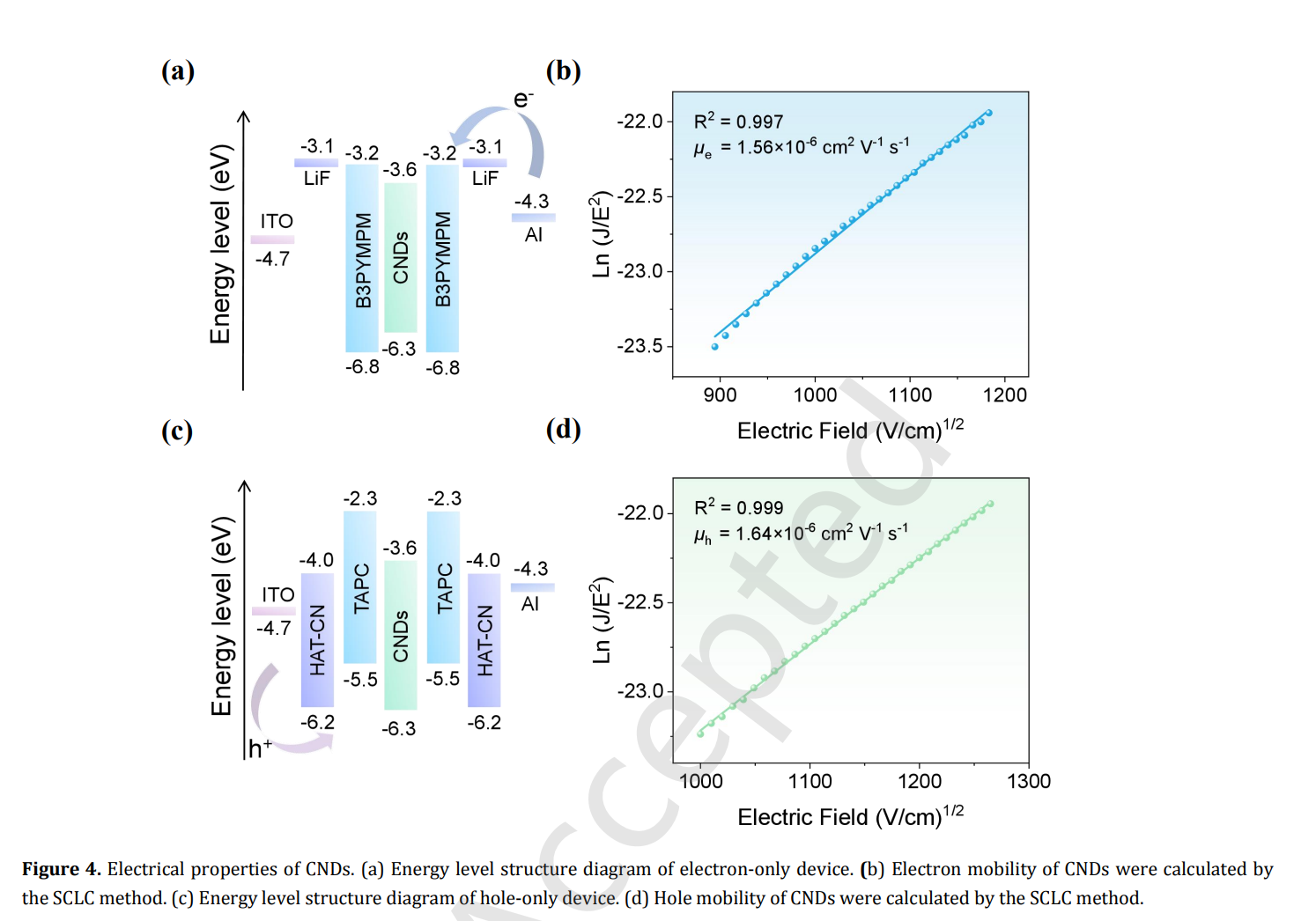
All of these carbon nitride dot-based LEDs exhibit extremely low external quantum efficiency and high turn-on voltage. To date, carbon nitride dot-based LEDs with outstanding performance have not yet been reported, and their fluorescence efficiency, charge injection kinetics, and interfacial energy-level alignment remain to be elucidated.
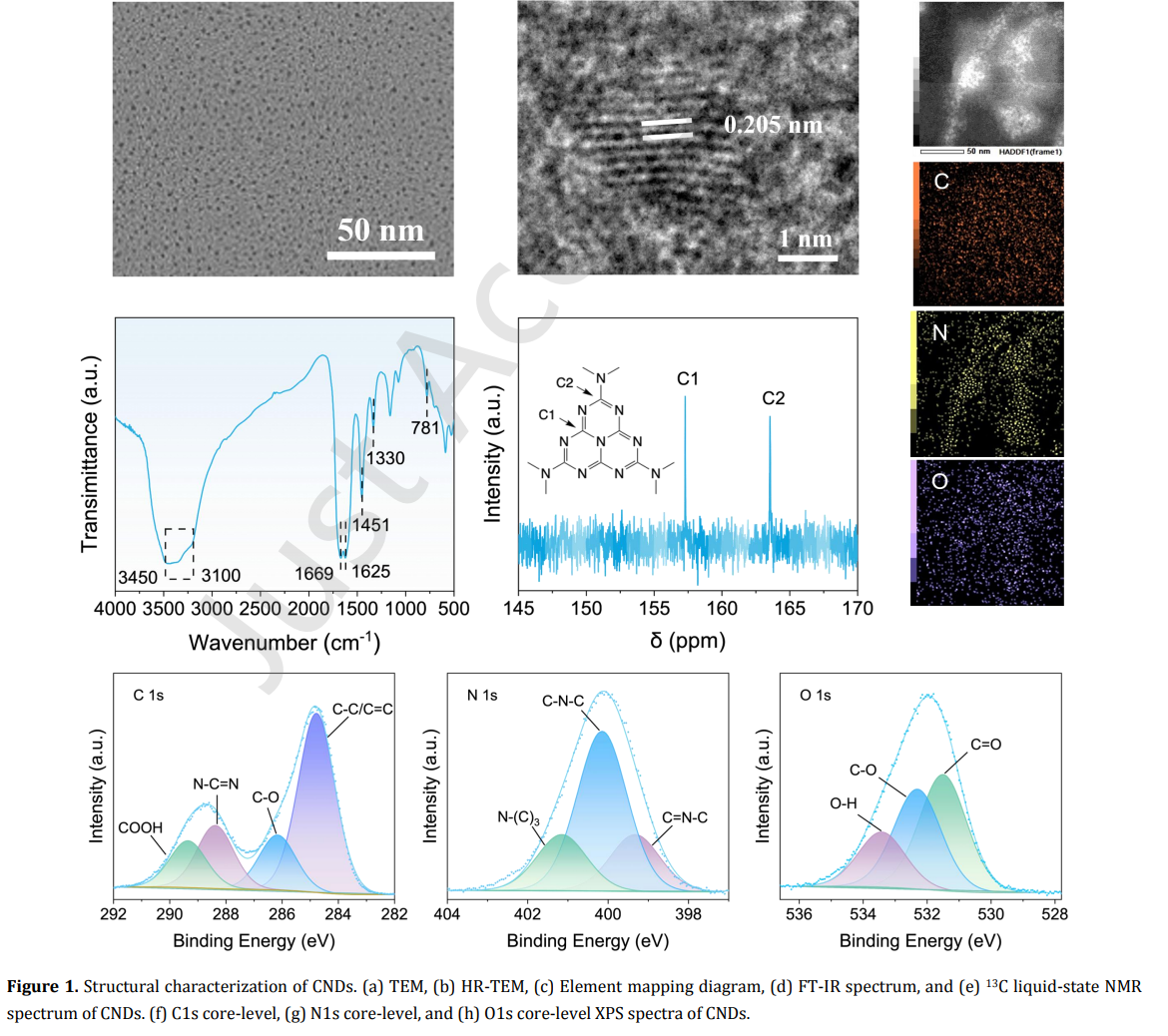
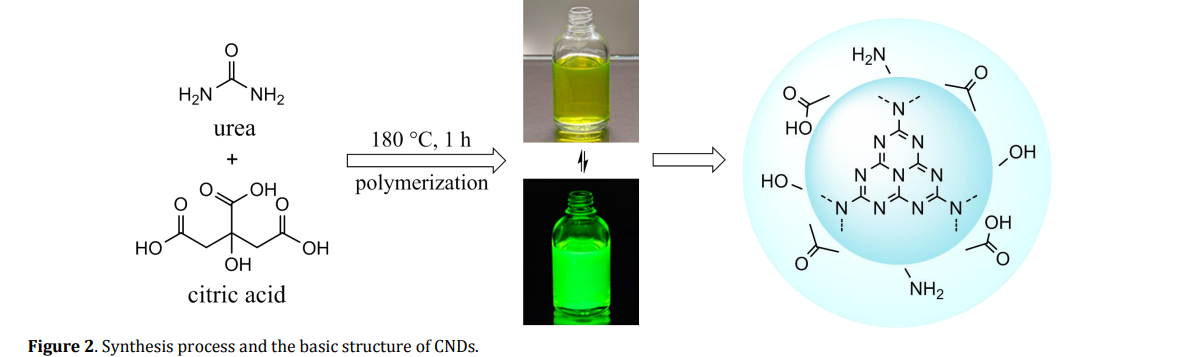
Xing Jun and colleagues from Qingdao University of Science and Technology have, for the first time, reported high-performance light-emitting diodes based on solvent-free polymerized carbon nitride dots. Using a simple bottom-up approach, high-quality carbon nitride dots were synthesized by thermally polymerizing citric acid and urea under ambient atmosphere.
Their excellent dispersibility in various solvents (ethanol, isopropanol, and acetone) enables solution-processed emissive layers with uniform morphology.
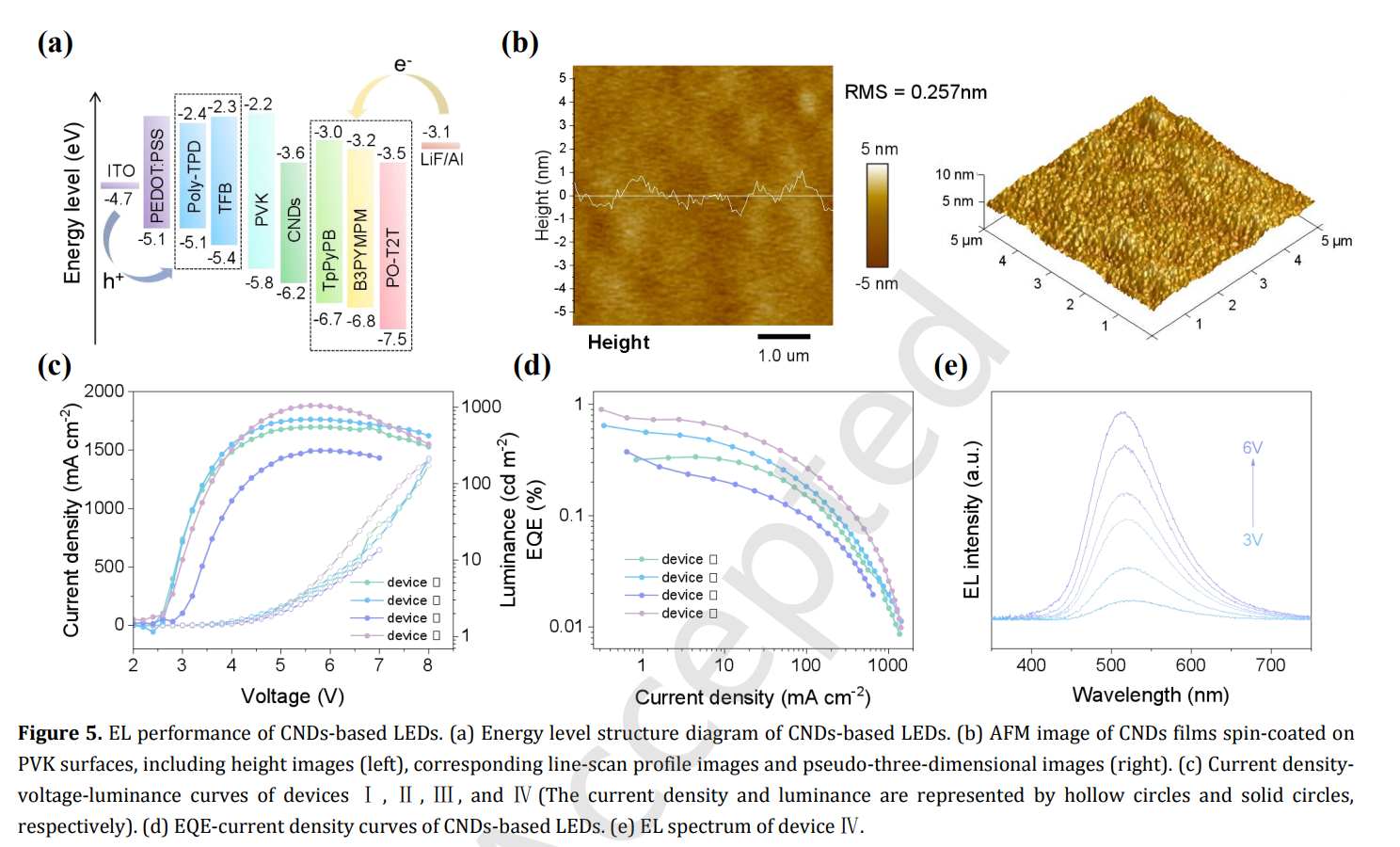
The carbon nitride dot colloidal solution exhibited excellent stability, remaining clear and uniform with no observable precipitation after six months of storage at room temperature. The carbon nitride dots achieved an outstanding photoluminescence quantum yield of 72%. The fabricated carbon nitride dot–based light-emitting diodes emitted green light with color coordinates of (0.28, 0.47).
Compared with previously reported carbon nitride dot–based LEDs, the devices with an optimized architecture achieved a milestone maximum luminance of 1047 cd m⁻² and an external quantum efficiency of 0.9%.