
Wenzhou University Research Team Enhances Unusual Bending Performance of Flexible Blue Perovskite LEDs Through Dynamic Hydrogen-Bond Induction
In recent years, perovskite optoelectronic devices have attracted significant attention due to their low cost and high photoelectric conversion efficiency. Through continuous in-depth research, the power conversion efficiency of perovskite solar cells has exceeded 27%, while perovskite light-emitting diodes (LEDs) have achieved external quantum efficiencies of over 20% in the red, green, and blue spectral regions.
Extensive research has focused on optimizing perovskite films, electrodes, and substrates so that flexible devices can maintain high performance even after thousands of bending cycles. As a key component of these devices, however, the inherent brittleness and rigidity of perovskite films limit their flexibility and practical application.
To address this issue, researchers have developed various strategies, such as incorporating self-healing polymers into perovskite films to simultaneously enhance flexibility and device performance. Polymers embedded within the perovskite film can absorb mechanical stress during stretching or bending. As the stress increases, intramolecular and intermolecular bonds within the polymer matrix at the interface break, leading to crack formation and thus facilitating stress release. Subsequently, under a controlled atmosphere, the broken polymers can self-heal through the reformation of bonds within the polymer matrix under external stimuli, thereby partially restoring the device's performance.
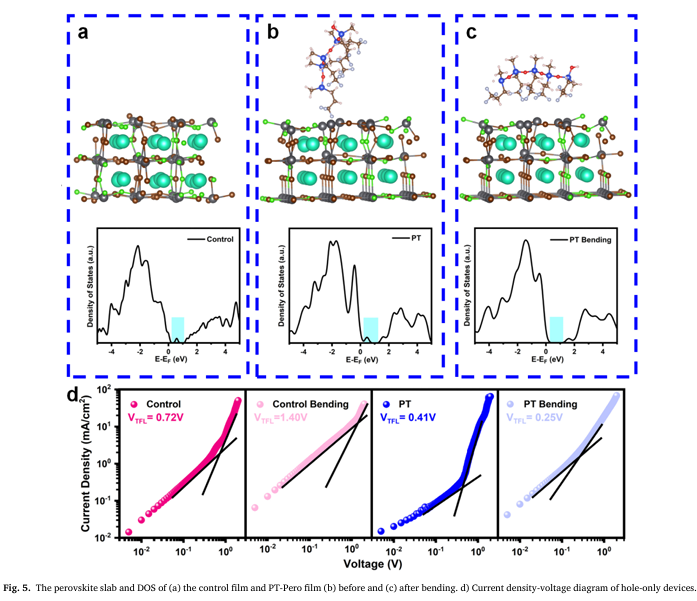
For example, Sun et al. introduced (3,3,3-trifluoropropyl)trimethoxysilane (PT) into the perovskite precursor to fabricate green PeLEDs with an external quantum efficiency of 16.2%. After thermal treatment at 100℃ for 30 minutes, the crosslinked polymer network was reconstructed, allowing the device to retain 75% of its initial efficiency after 1,000 bending cycles.
Similarly, Tang et al. doped polyurethane into the perovskite layer to enhance the performance and flexibility of sky-blue PeLEDs. Through the formation of hydrogen bonds within the polyurethane, cracks induced by bending could be repaired through thermal treatment.
To date, most studies have mainly focused on flexible perovskite solar cells containing polymers such as polyurethane. However, flexible PeLEDs—especially blue-emitting devices—have received relatively little attention, despite their crucial role in a wide range of applications including flexible displays and lighting. Moreover, the reported polymer self-healing processes typically require prolonged thermal treatment, which may damage device efficiency and the phase stability of perovskite films.
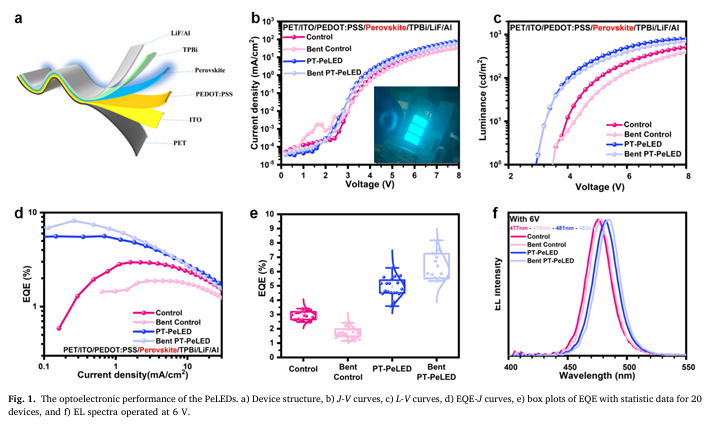
Researchers Zou Chao, Zhai Lanlan, Huang He, and colleagues from Wenzhou University introduced PT into perovskites to fabricate blue-emitting flexible PeLEDs. After PT modification, the PeLEDs achieved an external quantum efficiency (EQE) of 5.62% at 481 nm, representing a significant improvement compared with devices without PT.
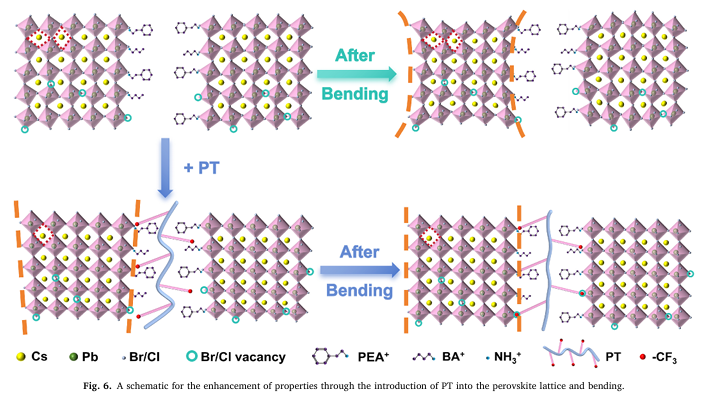
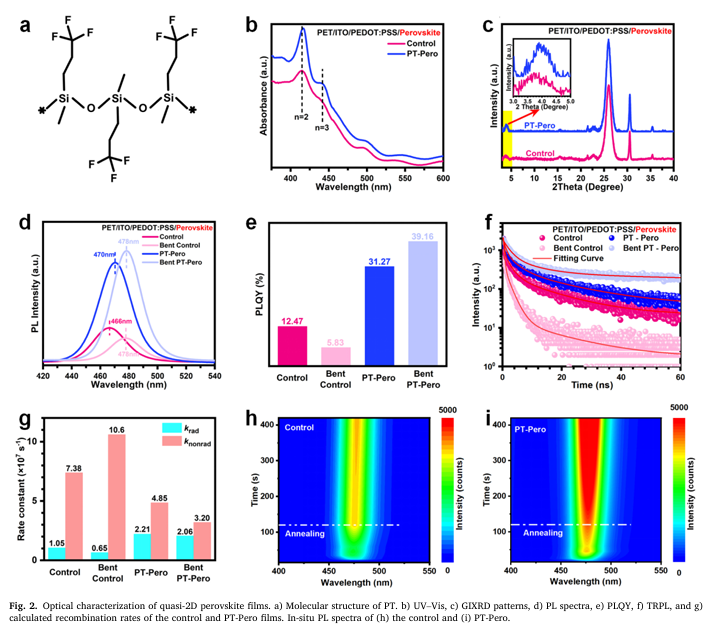
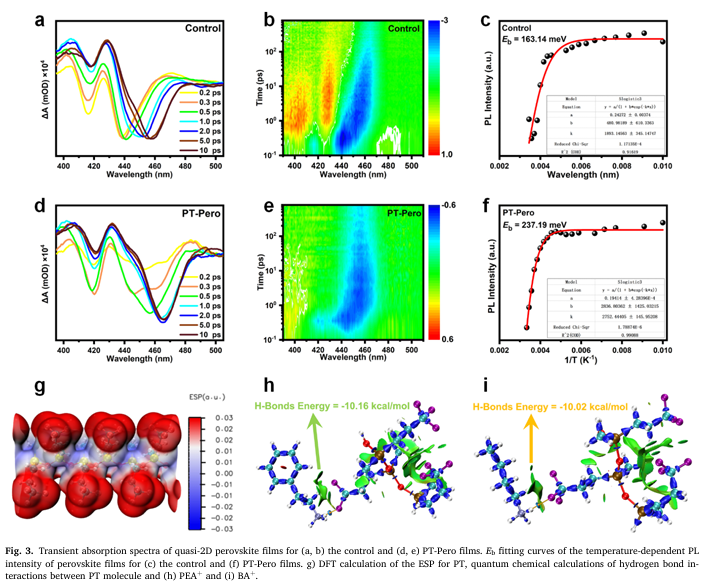
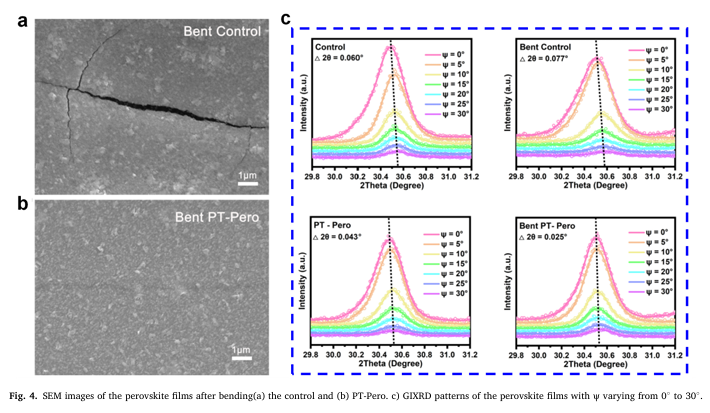
The flexible Si–O–Si backbone of PT enables it to migrate to the interface of the perovskite layer and form N–H···F hydrogen bonds, thereby protecting the crystal structure from fracture. After thousands of bending cycles—without the need for thermal treatment—dynamic hydrogen bonding between the –CF₃ groups in PT and the –NH₃⁺ groups in the perovskite promotes device recovery without external stimulation.
This self-healing mechanism based on dynamic hydrogen bonding differs from previously reported approaches. As a result, the EQE at 483 nm increased to 8.18%, reaching 145% of the original value. The study not only achieves high device performance but also significantly improves the optoelectronic properties and mechanical flexibility of PeLEDs while reducing overall cost.