
Guangdong and Zhejiang Together Account for 66% of Lighting Exports—Industrial Supporting Capacity Is Being Magnified by Data
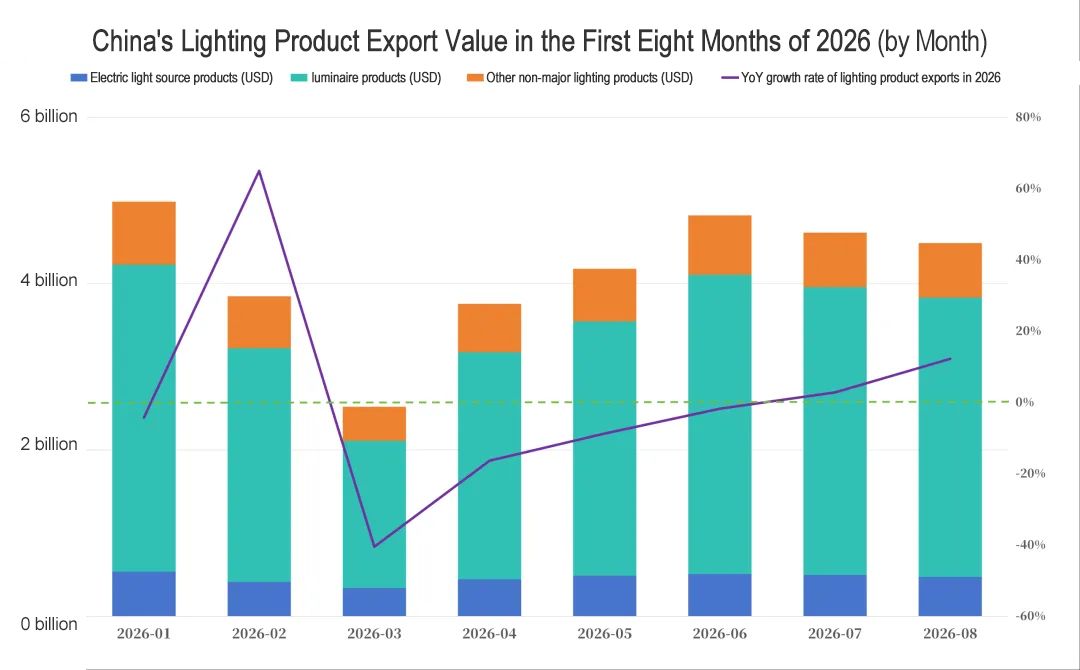
With the lighting industry data for the first three quarters of 2026 now released, breaking down the export data to the provincial level reveals a fact that lighting enterprises should take seriously: Guangdong and Zhejiang together account for approximately 64.7% of the country's total lighting product export value. Of this, Guangdong accounts for about USD 9 billion and Zhejiang about USD 6.6 billion, bringing the two provinces' combined total to approximately USD 15.6 billion, while the national total export value is approximately USD 24.1 billion (first-half data). This is not a new phenomenon, but its implications are changing.
Ⅰ. The "Counter-Cyclical Concentration" of Guangdong and Zhejiang
Against the backdrop of a nationwide year-on-year decline in lighting product exports of approximately 3% to 7%, the export performance of Guangdong and Zhejiang presents a different picture. According to data from the China Association of Lighting Industry, in the first half of 2026, Guangdong's lighting product export value was approximately USD 9 billion, up 2% year on year; Zhejiang's was approximately USD 6.6 billion, up 10% year on year. Together, the two provinces account for 66% of the national total export value, and their share is still rising.

What does this mean? The export growth of Guangdong and Zhejiang has been achieved against the backdrop of a shrinking national export market. The export decline in other production regions is actually larger than the national average. The advantage of industrial supporting capacity is being "converted" into export competitiveness—when overseas customers cut orders and raise compliance requirements, they tend to choose the production regions with the most complete supply chains and the most stable delivery. Guangdong and Zhejiang happen to satisfy both conditions.
Ⅱ. The Structural Divergence Behind the Data
The deeper issue is that the "counter-cyclical growth" of Guangdong and Zhejiang's exports is itself undergoing internal divergence.

In terms of product structure, the export volume of LED modules grew by 53% year on year, but the average export price fell by 25% year on year. The growth in export volume has largely been achieved at the expense of price. Meanwhile, photovoltaic LED lighting devices were the only category to achieve "double growth" in both export value and average price, with export value to the North American and African markets growing by 22% and 14%, respectively. This indicates that even within Guangdong and Zhejiang, the categories pursuing "volume" and the categories pursuing "quality" are moving onto completely different trajectories.
In terms of market structure, exports to the United States totaled approximately USD 6.2 billion, down 9% year on year, with their share falling to 19%; exports to Africa totaled approximately USD 2.5 billion, up 9% year on year, with their share rising to 8%. Luminaire exports to Africa grew by 11%, with countries such as Egypt, Morocco, and Côte d'Ivoire maintaining growth rates above 9%. More notably, the average export price of photovoltaic LED lighting products to African markets such as Nigeria and Kenya has reached more than twice that of comparable products in European and American markets—Africa is not a "low-price, volume-driven" market, but has seen segmented demand for high-value, high-unit-price products emerge.
This means that the export growth of Guangdong and Zhejiang is not simply a matter of "holding the base," but of simultaneously switching in both market structure and product structure. The contraction in exports to the United States has been partially offset by incremental growth in Africa and Europe, and the "price-for-volume" approach of low-end LED modules has been hedged by the "simultaneous rise in volume and price" of photovoltaic LED lighting devices.
Ⅲ. What It Actually Means for Lighting Enterprises
For lighting enterprises outside Guangdong and Zhejiang, this set of data presents a reality that needs to be confronted squarely: the gap in industrial supporting capacity is being magnified by export data.

When overseas customers face multiple pressures—compliance reviews, delivery cycles, and product consistency—they tend to concentrate orders in production regions with the most mature supply chains. This "concentration" trend is not obvious during an industry upswing, but it accelerates during a downturn. The export share of Guangdong and Zhejiang rose from 64% in the same period of 2025 to 66%; this 2-percentage-point change corresponds to the substantial loss of orders in other production regions.
For enterprises in Guangdong and Zhejiang, challenges also exist. Behind the export growth lies the profit erosion caused by the "price-for-volume" approach in low-end categories, as well as the investment pressure of "certification thresholds + localized services" in high-end categories. The high unit prices of photovoltaic LED lighting devices in the African market correspond to investments in product adaptation for off-grid power supply scenarios, after-sales systems, and channel development—these cannot be accomplished simply by "shipping a container of goods."
Ⅳ. Conclusion
The export share of Guangdong and Zhejiang is approaching two-thirds; the figure itself is not surprising. But the trend of industrial concentration it reflects is advancing faster than the industry expected. For the lighting industry, export competition is no longer about "whose products are better," but about "whose supply chain is more complete, whose compliance capability is stronger, and who better understands the real needs of different markets." Under this logic, the gap in industrial supporting capacity will continue to be magnified by export data, and closing this gap requires more than the efforts of just one or two enterprises.