Industry Analysis — Global Commercial Lighting Fixture Market to Reach RMB 194.8 Billion in 2026
Commercial lighting fixtures are lighting products specifically designed for commercial spaces. They are widely used in offices, retail stores, hotels, restaurants, factories, schools, and other public and commercial environments. Compared with residential lighting, commercial lighting typically requires higher brightness, longer service life, and greater energy efficiency to meet the demanding lighting requirements of commercial spaces.
Commercial lighting encompasses a wide range of products, including pendant lights, ceiling lights, spotlights, track lights, panel lights, and downlights, each designed for specific functions and application scenarios.
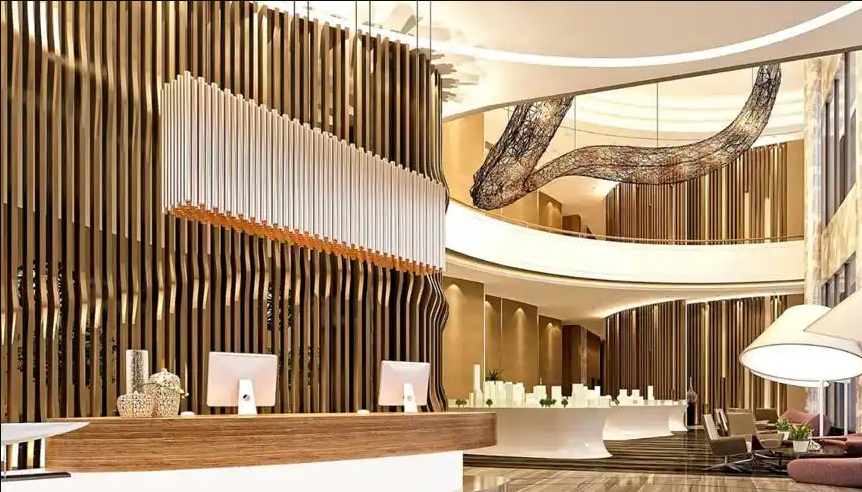
Modern commercial lighting fixtures predominantly use LED technology, which has become the mainstream choice due to its energy efficiency, long lifespan, and low maintenance costs. At the same time, commercial lighting design increasingly emphasizes not only functionality but also spatial aesthetics, allowing lighting fixtures to complement architectural styles and interior décor while enhancing the overall visual experience.
In addition, many modern commercial lighting systems are equipped with smart control technologies, supporting functions such as dimming, color temperature adjustment, and scheduled operation. These intelligent features provide greater convenience while further improving energy efficiency and operational performance.
Ⅰ. Commercial Lighting Fixture Market Size and Future Growth Forecast
Energy management and low-carbon regulations introduced worldwide are continuously accelerating the replacement of traditional lighting systems in commercial buildings. To reduce long-term energy consumption, building operators are increasingly undertaking lighting renovation and retrofit projects, while newly constructed commercial properties are prioritizing compliant, energy-efficient lighting fixtures from the outset. These trends continue to generate demand for both replacement and new procurement of commercial lighting fixtures, supporting sustained market growth.
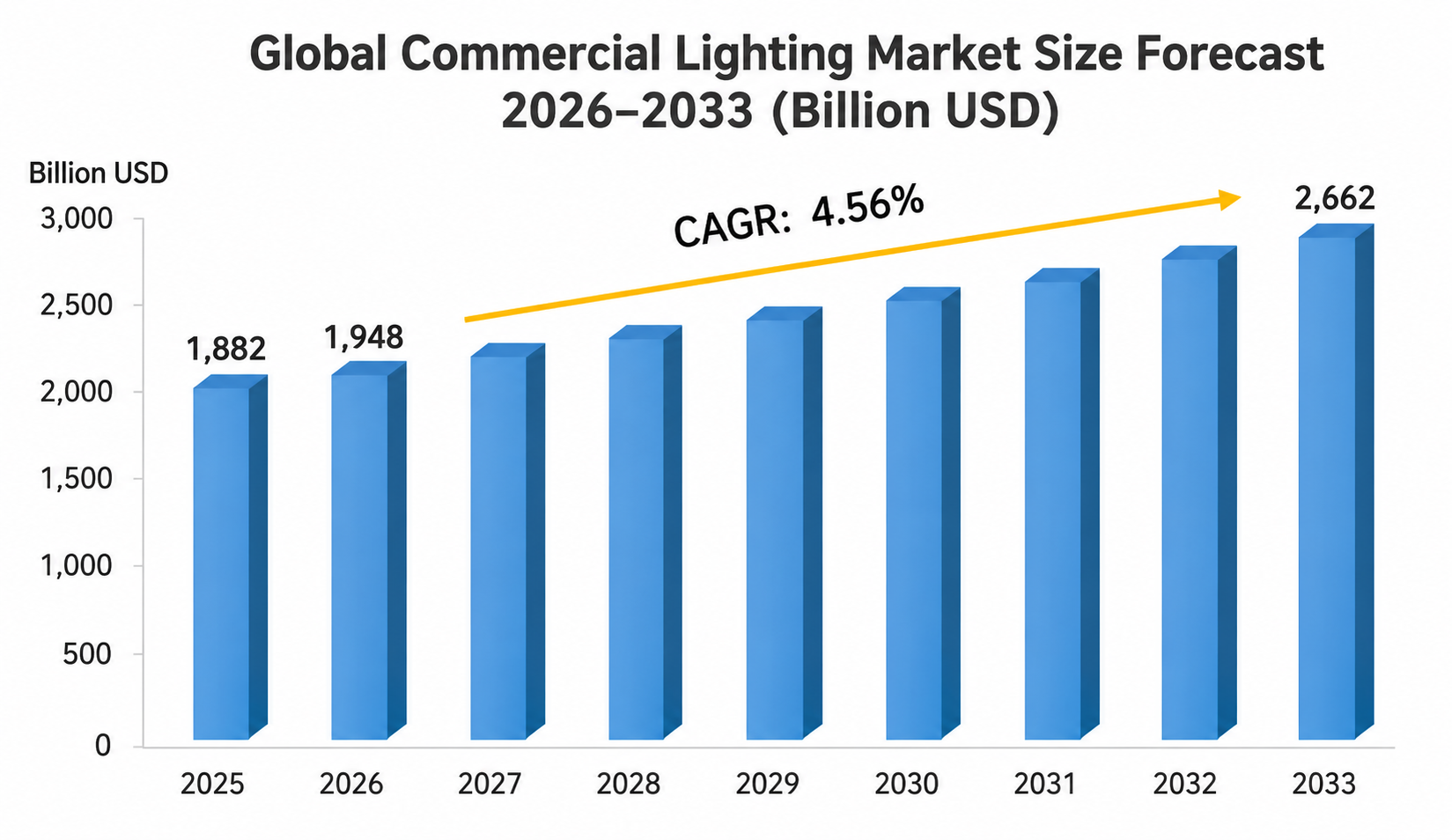
In 2026, the global commercial lighting fixture market is expected to reach RMB 194.8 billion. Looking ahead, the market is projected to grow at a compound annual growth rate (CAGR) of 4.56%, reaching approximately RMB 266.2 billion by 2033.
Ⅱ. Commercial Lighting Fixture Market Size and Future Growth Forecast
According to an in-depth analysis by Wenkehui, the global commercial lighting fixture market is highly competitive. Major market participants include Philips, OSRAM, General Electric, Cree, Panasonic, Eaton, Thorn, Hubbell Lighting, Acuity Brands Lighting, TOSHIBA, Targetti Sankey, Asian Electronics, SIMKAR Corporation, LSI Industries, Thorlux Lighting, Evolution Lighting, KALCO Lighting, Foshan Lighting, OPPLE Lighting, NVC Lighting, and Yankon Lighting, among others. The top five manufacturers collectively account for approximately 72% of the global market.
The global commercial lighting fixture market has a large and diverse pool of participants. Manufacturers in different regions leverage their respective local industrial strengths to establish differentiated market positions, resulting in a moderate level of market concentration. Leading companies have built competitive advantages through comprehensive global distribution networks, established R&D capabilities, and standardized product portfolios. They continue to invest in technological innovation and develop multi-scenario lighting solutions to strengthen their market positions, while small and medium-sized manufacturers tend to focus on niche applications to secure their market share.
In China, the number of domestic participants in the commercial lighting fixture market continues to grow, while market concentration is steadily increasing. Leading manufacturers have accumulated extensive project resources across diverse commercial applications and leverage well-developed local supply chains to control overall production costs. At the same time, they continue to expand their market share through product innovation and broader distribution channels. A large number of small and medium-sized manufacturers remain concentrated in the basic lighting product segment, competing primarily for regional orders through their flexible customization capabilities.
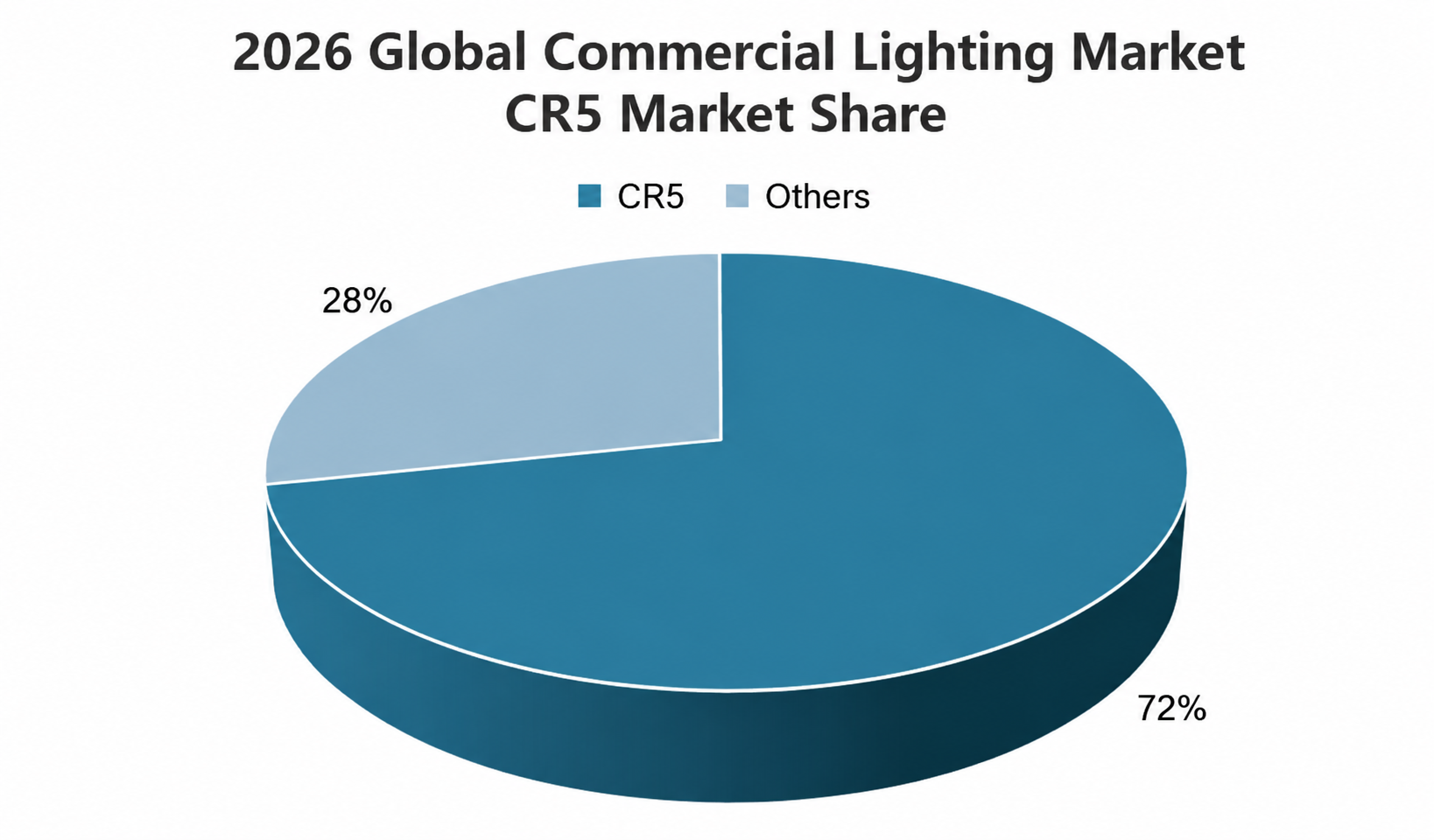
The following companies are among the major participants in the global commercial lighting market. Through innovative solutions and extensive product portfolios, they continue to drive the development of the global market.
1. Philips
Headquarters: Netherlands
Company Overview & Core Business: Philips Lighting, now operating under Signify, has a long-standing presence in the lighting industry. Its business covers professional commercial lighting, smart connected lighting systems, and supporting lighting control solutions. Key products include commercial LED downlights, track spotlights, linear office luminaires, and associated smart lighting equipment. With a strong brand heritage, extensive global distribution network, and substantial technology and patent portfolio, the company is capable of delivering integrated lighting solutions across multiple application scenarios. It remains among the leading players in the global commercial lighting market and enjoys strong recognition in commercial projects both in China and overseas, continuing to drive the adoption of smart lighting solutions.
2. OSRAM
Headquarters: Germany
Company Overview & Core Business: Originating in Germany, OSRAM has more than a century of accumulated expertise in lighting technology. Its business covers professional commercial luminaires, light-source components, and smart lighting control solutions. Key products include commercial track spotlights, linear lighting fixtures, recessed downlights, and associated driver components. The company has deep expertise in optoelectronics and light-source technologies, supported by an established global distribution network and rigorous quality-control system. Its optical and light-source R&D capabilities are particularly strong. OSRAM remains a leading brand in the global commercial lighting market, with solid recognition in high-end commercial projects and professional retail lighting, and continues to provide high-quality integrated commercial lighting solutions.
3. General Electric
Headquarters: United States
Company Overview & Core Business: General Electric (GE) has a long history of technological development in the lighting industry, with its lighting business now operating independently. Its business covers commercial LED luminaires, traditional light sources, and intelligent commercial lighting control systems. Key products include commercial downlights, high-bay and industrial luminaires, retail spotlights, and supporting lighting driver components. Leveraging its strong technological heritage, established North American distribution network, and stringent product standards, GE maintains a strong presence in the North American commercial lighting market. It continues to provide standardized lighting solutions for commercial retrofit projects worldwide and remains an established and influential player in the global commercial lighting sector.
4. Cree
Headquarters: United States
Company Overview & Core Business: Originating in the United States, Cree entered the lighting industry through its early expertise in LED chip technology, with its lighting business now operating independently. Its business covers commercial LED light-source components, finished commercial luminaires, and supporting optical solutions. Key products include high-power commercial LED packages, retail and supermarket track lighting fixtures, and industrial/commercial lighting modules. With strong expertise in fundamental LED chip and optical technologies, the company offers notable performance in luminous efficacy and color rendering. Cree has established a solid customer base in the North American commercial lighting market and enjoys strong recognition within the high-end commercial lighting supply chain, making it an important participant in both upstream LED technology and finished commercial lighting products.
5. Panasonic
Headquarters: Japan
Company Overview & Core Business: Panasonic is a diversified Japanese multinational manufacturer with businesses spanning professional commercial lighting fixtures, smart lighting control systems, and architectural lighting solutions. Key products include commercial track spotlights, linear office luminaires, recessed downlights, and dimming control components. The company benefits from long-term optical R&D expertise and stringent quality-control standards, while leveraging its well-established distribution network across Asia to serve commercial projects. Panasonic maintains strong brand recognition in the Asian commercial lighting market and is highly competitive in office, retail, and hospitality lighting, making it an important international player in the global commercial lighting sector.
Ⅲ. Regional Distribution of the Global Commercial Lighting Fixture Market
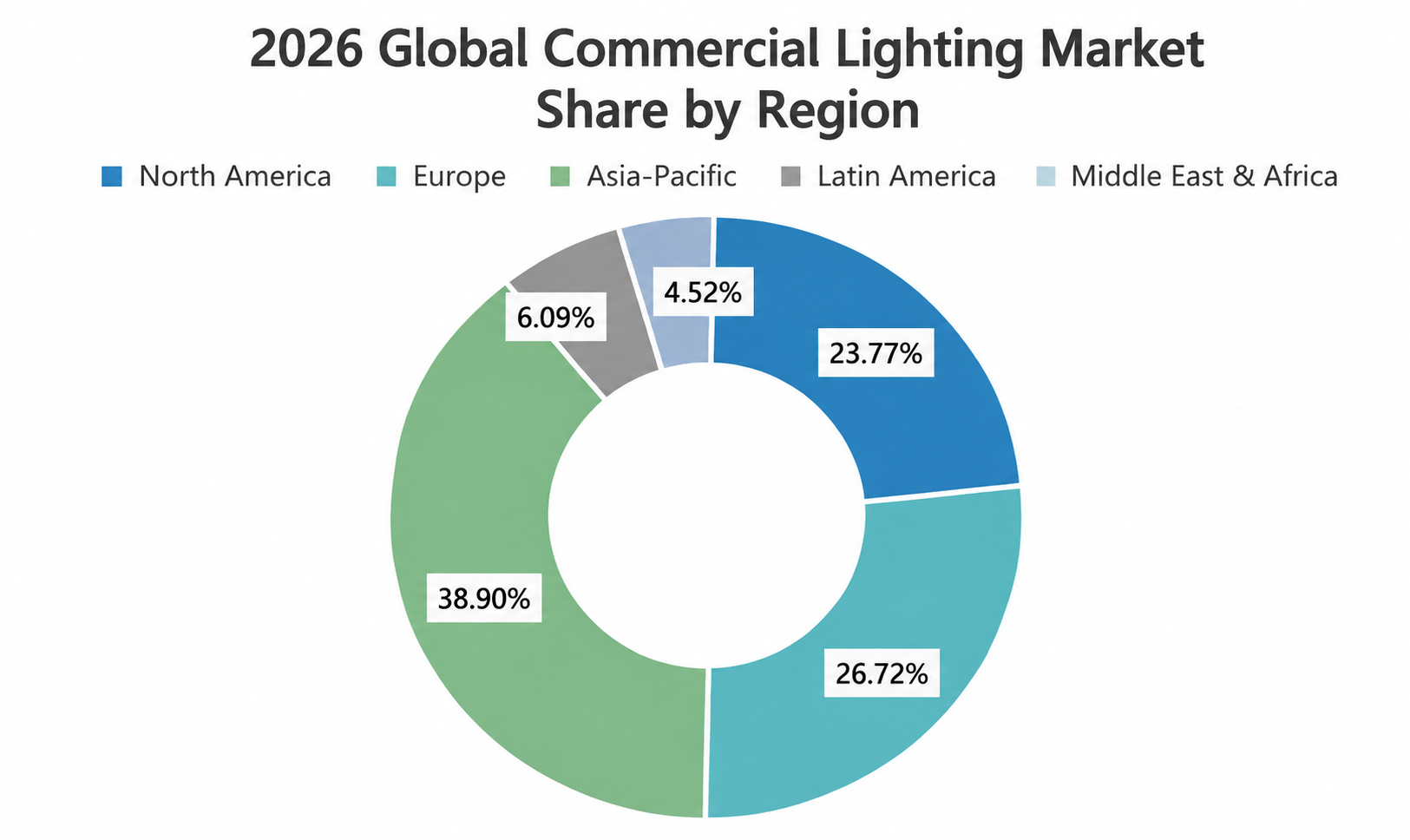
According to an in-depth analysis by Wenkehui, the Asia-Pacific region holds the largest share of the global commercial lighting fixture market, accounting for 38.90%. The region benefits from a well-established upstream and downstream industrial chain and large-scale manufacturing capacity among local producers. Numerous economies across the region continue to invest in new commercial buildings and retrofit existing lighting systems. The implementation of energy-efficiency policies is also generating substantial replacement demand. In addition, multinational lighting companies have established manufacturing facilities and regional operation centers throughout the region, supporting continued market expansion.
Europe accounts for 26.72% of the global market. The region has introduced stringent energy-efficiency and environmental regulations governing commercial lighting products. High-end commercial projects tend to favor lighting solutions with advanced optical technologies, while local manufacturers focus on premium and specialized segments. International brands compete through standardized product portfolios, and the ongoing renovation of existing commercial spaces continues to generate stable procurement demand.
North America represents 23.77% of the global market. The region has a highly standardized and mature market, with strong acceptance of smart and connected commercial lighting systems. Local brands benefit from well-established distribution channels, while imported lighting products provide effective alternatives for mid-range projects. Continued commercial real estate development, together with the renovation and replacement of aging infrastructure, supports stable long-term market demand.
Latin America accounts for 6.09% of the global market. Commercial construction activity continues to develop steadily, while market supply relies heavily on imported products. The gradual introduction of energy-efficiency regulations across the region is accelerating the replacement and upgrading of lighting products. Multinational companies are leveraging established distribution networks to explore demand across local commercial applications, creating further room for market growth.
The Middle East and Africa region accounts for 4.52% of the global market. The continued construction of commercial complexes is generating new demand for lighting products, while limited local manufacturing capacity means that the market relies heavily on imported products. Energy-related policies are gradually encouraging the replacement of traditional light sources, creating ongoing opportunities for the expansion of various commercial lighting solutions.
Ⅳ. In-Depth Analysis of Commercial Lighting Fixture Segments and Their Characteristics
Commercial lighting fixtures can be broadly segmented into LED luminaires, CFL luminaires, LFL luminaires, HID luminaires, and halogen lamps. LED luminaires account for the largest installed base among all commercial lighting categories. They are suitable for a wide range of commercial applications, including retail stores, supermarkets, offices, hotels, and other commercial spaces, while accommodating diverse installation conditions and lighting requirements. A large number of existing commercial buildings continue to adopt LED products as part of lighting retrofit and renovation projects, creating a substantial installed base. At the same time, LED luminaires are also widely specified for newly constructed commercial projects.
LED lighting also has the fastest growth rate among the major commercial lighting categories. Continuous technological improvements are driving product upgrades, while smart connectivity and intelligent control functions are increasingly being integrated into luminaire designs. Newly constructed commercial infrastructure projects are increasingly prioritizing LED solutions, while replacement demand from existing lighting systems continues to shift toward LED products. As a result, LED lighting is expanding at a significantly faster pace than other commercial lighting categories.
Ⅴ. Market Performance and Demand Analysis of Downstream Commercial Lighting Applications
Commercial lighting fixtures are widely used across residential, retail, healthcare, hospitality, industrial, office, and other application segments. Office buildings represent the largest application segment for commercial lighting fixtures. A large number of continuously operating office buildings generate stable demand for both lighting installations and replacement products. These spaces have standardized requirements for lighting comfort, color rendering, and visual performance. The substantial installed base of existing office buildings continues to generate procurement demand, providing fundamental market support for the commercial lighting industry.
Retail is the fastest-growing application segment for commercial lighting fixtures. Physical stores are continuously upgrading their lighting schemes to enhance product presentation and create more engaging shopping environments. The expansion of branded retail stores and renovation of existing outlets are generating ongoing demand for new lighting installations. Because retail environments place greater emphasis on customized lighting and visual presentation, they are accelerating the adoption of high-end commercial lighting products and encouraging manufacturers to develop targeted, integrated lighting solutions, further driving the optimization and upgrading of the industry's product mix.